
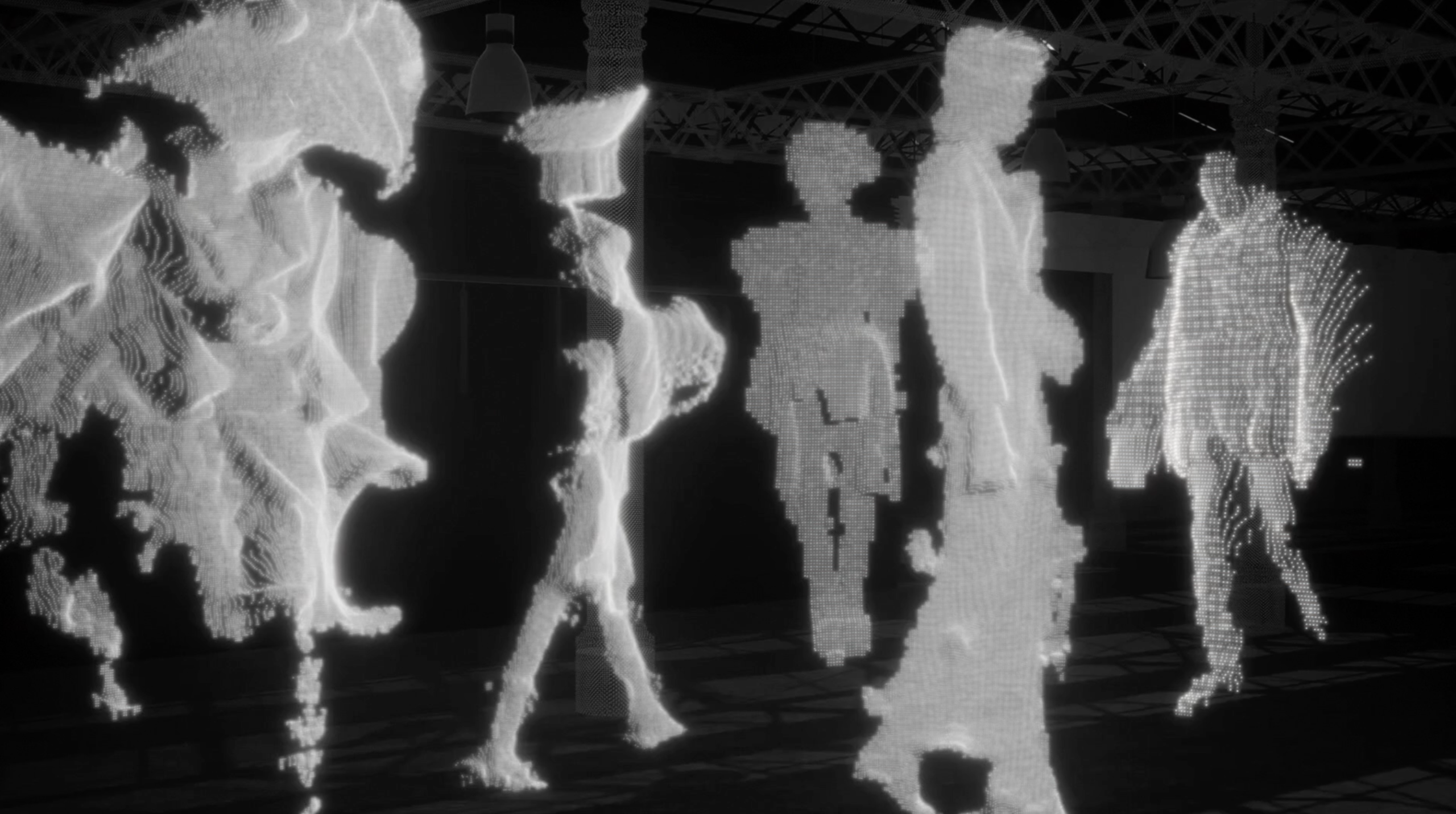
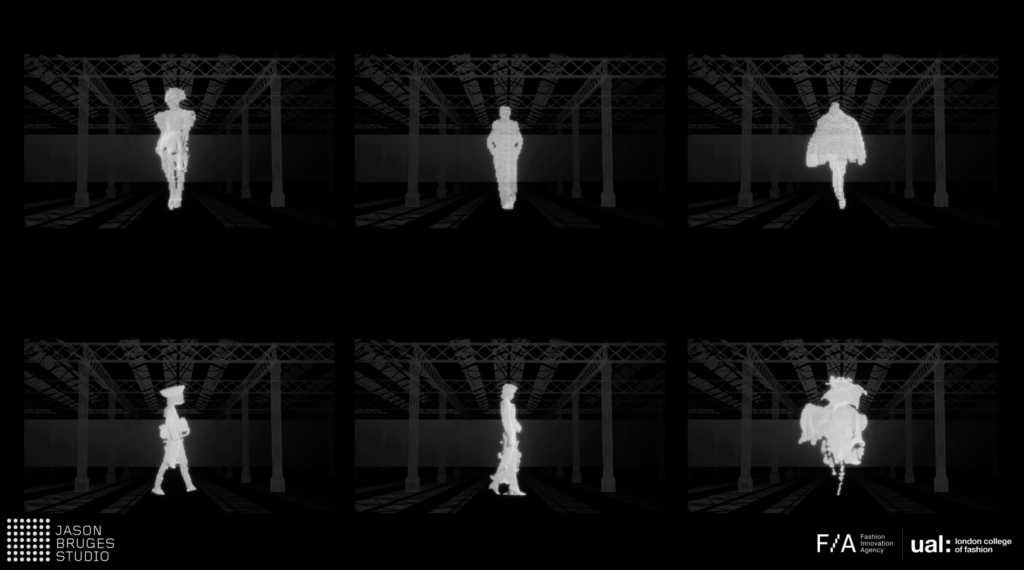

Jason Bruges, founder of Jason Bruges Studio, reflected on the work: “Digital Umbra reimagined what a distorted version of Spitalfields Market could feel like. By blurring the lines between the physical and virtual worlds, our goal was to create an environment where visitors became active participants, feeling the true weight of their own presence within the space. We were thrilled to collaborate with Fashion Innovation Agency, exploring how fashion, movement, and the human body can exist in dialogue with art and technology.“
To find out more about the ideas behind Digital Umbra and what it took to bring it to life, we sat down with Costas Kazantis, Lead Creative Technologist at Fashion Innovation Agency, UAL.
We first met Jason during Art Basel Miami a few years ago, where conversations naturally emerged around the overlaps between our respective practices. Art Basel brought together voices from contemporary art, design, architecture, technology and fashion, creating an environment where new forms of collaboration could emerge across disciplines.
What immediately resonated with us was Jason Bruges Studio’s interest in creating spatial experiences that audiences could inhabit and actively participate in. At the Fashion Innovation Agency, we had long been exploring similar questions through fashion, looking at how garments, bodies and digital technologies could transform the way people experienced space and storytelling.
Through projects ranging from immersive installations to our collaborations with ILMxLAB, we had always been interested in how digital layers could augment physical experiences rather than replace them. In many ways, Digital Umbra sat at that intersection.
What surprised me most about this collaboration was the process of translating fashion movement and sculptural volume into an abstract spatial language. While we often worked with technologies such as motion capture and real-time 3D environments, Digital Umbra took a more poetic approach, transforming bodies, shadows and movement into evolving digital traces that felt both architectural and ephemeral.
Digital Umbra explored how immersive media could transform movement into an evolving spatial experience.
The installation invited audiences to engage with shadow not as absence, but as material. Through a combination of depth cameras, shadow mapping and real-time interaction, bodies, garments and gestures were captured as living streams of spatial data and translated into shifting point clouds and digital traces visualised within a 3D interpretation of Spitalfields created in Unreal Engine 5.
As visitors moved through the installation, their presence actively reshaped the environment around them. The experience became a continuous dialogue between body, space and technology, encouraging participants to become aware of how they occupied and transformed their surroundings.
At its core, Digital Umbra was about reimagining both movement and place. It offered a shared environment suspended somewhere between the physical and virtual world, where shadows became architecture and participation became part of the work itself.
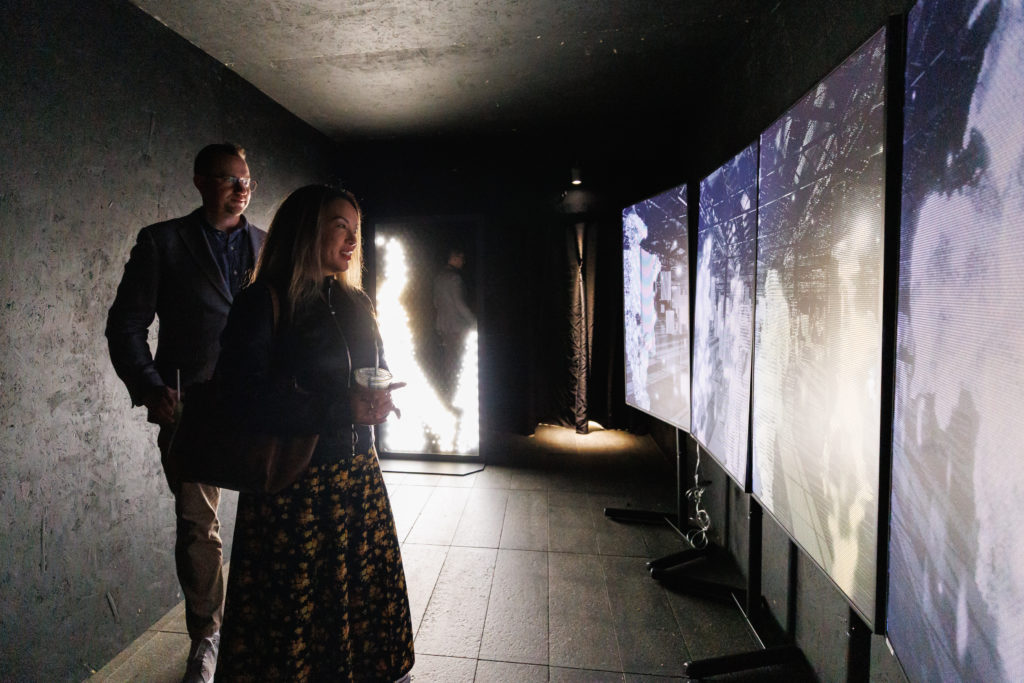
People were increasingly looking for meaningful ways to connect with one another, and immersive live experiences had become powerful spaces for collective participation.
The most interesting opportunities emerged when digital technologies enhanced real-world experiences rather than attempting to replace them. Blurring the boundaries between physical and virtual environments allowed for new forms of interaction, storytelling and connection that remained grounded in shared human experiences.
There was also a growing desire to move beyond purely digital environments. While fully virtual experiences could be incredibly compelling, they could sometimes feel isolating. Projects like Digital Umbra explored how technology could instead bring people together in physical space, creating moments of collective engagement and discovery.
Fashion played a unique role in this conversation because it was inherently physical, social and embodied. Garments moved with us, responded to our bodies and communicated identity. By combining fashion with immersive technologies, it became possible to explore how the tangible qualities of clothing coexisted with digital layers, opening up new possibilities for how fashion was experienced, presented and understood.
Movement was one of fashion’s most important yet often overlooked qualities. The way a garment draped, flowed and responded to the body was central to how it was designed and experienced.
By capturing movement as spatial data, those qualities could be preserved and reinterpreted within digital environments. This made it possible to bring the behaviour of garments, bodies and performance into virtual worlds while maintaining a sense of authenticity and human presence.
More broadly, technologies that captured movement enabled the creation of digital experiences that felt more intimate, believable and responsive. Whether applied to immersive installations, digital characters or interactive environments, they allowed fashion to move beyond static representation and become something that could be inhabited, experienced and shared.
One of the things that made Digital Umbra most exciting was the way it emerged through collaboration across disciplines. The project brought together expertise from fashion design, styling, architecture, immersive technology, real-time 3D, set design and creative coding, demonstrating what became possible when different creative perspectives intersected.
The hope was that audiences left with a greater appreciation for the role collaboration plays in shaping new forms of cultural experience. Some of the most interesting innovations happened not within a single discipline, but in the spaces between them.
More broadly, the aim was for people to leave thinking differently about their own role within fashion experiences. Projects like Digital Umbra invited audiences to move beyond passive observation and become active participants in the creation of meaning. Through their movement, presence and interaction, visitors became part of a shared narrative that existed somewhere between the physical and virtual world.

To learn more about Jason Bruges Studio and Fashion Innovation Agency, visit jasonbruges.com and fialondon.com.
Subscribe to our newsletter for the latest Fashion District updates, and follow us to keep up-to-date with our latest events and opportunities: